

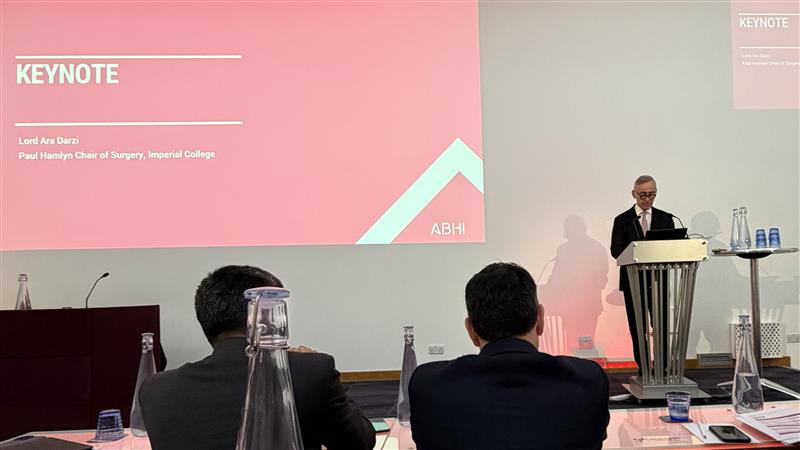
Many of the speeches at the Association of the British HealthTech Industry (ABHI) conference inspired hope about the future of the health service. The oratory and rhetoric of Lord Darzi and Minister for Health Innovation and Safety Dr Zubir Ahmed MP show leadership that has a clear vision for the future of healthcare in Britain and the substantial role that industry has to play.
The event came against the backdrop of the recent conclusion of NICE’s consultation on how HealthTech which meets standards will be recommended for NHS-wide implementation. When this eventually leads to implementable policy, industry will need to make a clear case for the value of prevention to the health service to avoid the challenges that pharmaceutical companies often face with their HTA process and the under-valuation of high-cost preventative treatments. Communicating this value to key decision-makers will be a substantial challenge, a fact that the conference made increasingly clear.
At the conference, the delegates were clear in their conversations; they are bought into that vision but are sceptical of the execution. With continued uncertainty in the wider economic environment, and previous opportunities to reform the health systems missed, there was a sense that many could only approach the optimism of the event with a sense of trepidation. This suggests that industry needs to make this reality clearer to decision makers; any criticism of the plans is borne out of caution rather than reluctance to be productive partners.
That is not to say the conference was a dour affair – quite the opposite. The speakers presented some fantastic case studies of how tech can and is being used in healthcare and life sciences.
Dr Niall Keenan, Consultant Cardiologist at West Hertfordshire Teaching Hospitals NHS Trust, laid out the clear utility of virtual wards, while Dr Prabs Arumugam, Clinical Innovation Lead at Amazon Web Services, discussed how AI integration into pathology will be game-changing.
Both came with clear caveats; firstly, technological integrations cannot be rolled out in isolation and require technological adoption at multiple stages and secondly, education of both healthcare professionals and the public is key to any success. The cost effectiveness of using tech to help with prevention was touted by numerous speakers, with compelling data to back this assessment.
There was a real enthusiasm for how HealthTech can transform lives. And the latest government policies such as the Innovation Passport announced in the summer promise to eliminate many of the repetitive frustrations industry currently faces.
There was also a larger discussion about decommissioning legacy technologies, to make way for new innovation, rather than continually adding to the pile. In principle this is a sensible approach, but one that raises more questions and leaves more scope for details to fall through the cracks. Newer technologies may not necessarily be able to meet the volume of older, cheaper tech. Nor is new always better than old. Therefore, budgets will likely need to change, as currently HealthTech receives a much smaller proportion of budget despite its impact – for example: in vitro testing only receiving 2% of total healthcare expenditure despite informing 70% of clinical decisions.
All these potential pitfalls to the widespread adoption of tech across the NHS were perhaps best summed up in the opening remarks made by Lord Darzi – his review and “three shifts” set out a roadmap, but that is by no means the same as driving a vehicle. There was an excess of willingness in the room to start up the engine (if you’ll allow me to extend the metaphor). But without thoughtful and effective adoption, these efforts could potentially stall and leave the car motionless.
Hearteningly, the industry panel at the end suggested a genuine willingness to collaborate, with both one another and government bodies. It is now a case of seeing if the open hand being
extended will be met by a government often finding itself focused on firefighting in the present rather than practically building for an exciting, tech-enabled future.
To discuss how your organisation can communicate your value effectively with decision makers, please don’t hesitate to get in touch.
Portland brings together expertise from across healthcare and life sciences, international development and technology. We enable clients to be bigger and bolder, engage priority audiences, and run campaigns that lift health and wellbeing around the world. Grounded in a clear view of health systems and powered by in-house research, our strategies align with rapidly changing policy across every level.