

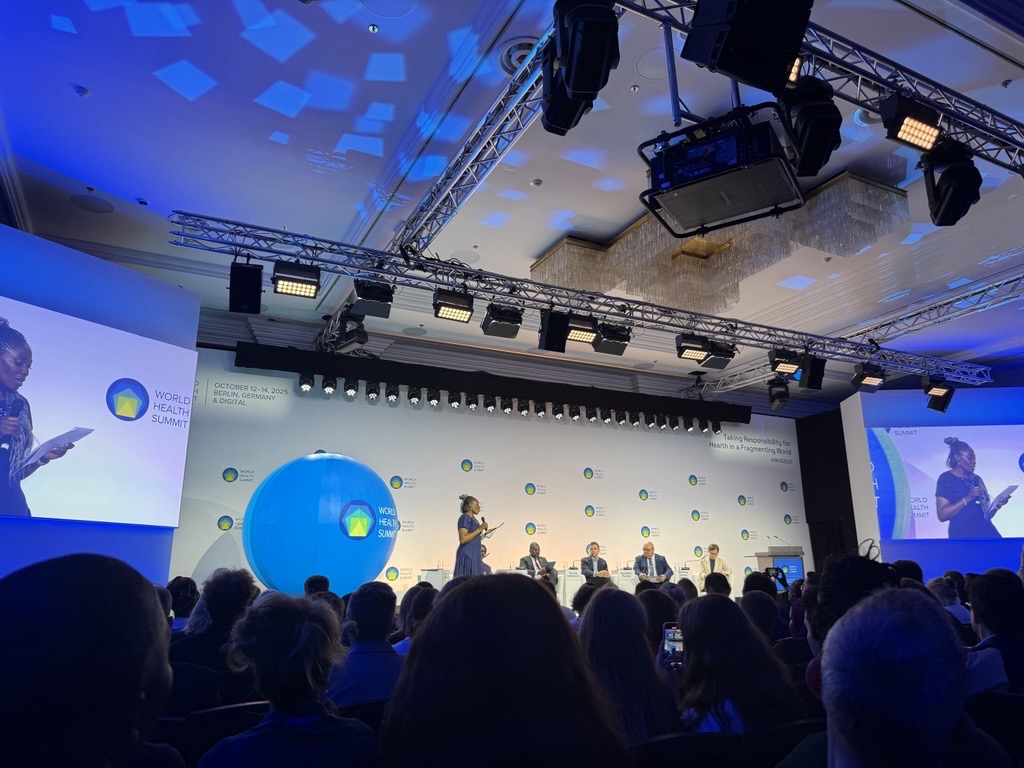
This week, Portland team members were excited to be on the ground in Berlin with more than 4,000 leaders from science, business, politics, and civil society at the World Health Summit. The theme, “Taking Responsibility for Health in a Fragmenting World,” set the tone for three high-energy days that made clear that it’s time for collective action. As Nina Warken, German Minister of Health, summarised, “national health depends on global health, and global health can only be achieved collectively.”
There was much to take away from the event on the biggest topics in global health policy – discussions ranged from treating health as an investment, to communicating science in ways that resonate with the public, driving urgency around non-communicable diseases (NCDs), securing sustainable financing, and fostering mission-led collaboration. Our team identified five key takeaways that will be most pressing for health and policy communicators:
- From cost to investment
Across multiple sessions, a key insight stood out: health must be reframed, not as a cost, but as an investment in prosperity and national resilience. Despite overwhelming evidence that prevention delivers high returns through lower system costs and better outcomes, only 3% of total health spending goes towards it. That imbalance undermines long-term sustainability. To build a healthier, more productive society, governments should work to shift budget priorities toward prevention. - Communicating science to build public and political will
Public understanding can translate into political will. When communication is clear, relatable, and rooted in everyday experience, people can see how innovation improves their lives, and policymakers are moved to act on evidence that resonates. Heidi Larson, founder of the Vaccine Confidence Project, remarked that we should “listen globally, act locally.” This principle applies to health communication strategies that respect local contexts while drawing on global insight. - Growing urgency on NCDs
NCDs account for 74% of global deaths, yet they continue to be under-prioritised and currently receive only around 1-2% of global financing for health. A true shift toward prevention-first approaches, from early detection and screening to healthier environments and lifestyles, demands long-term, sustained action that extends beyond political and electoral cycles. This is particularly vital for women’s health, where prevention often falls through the cracks. - Engineering a new global health system
Global health is facing a funding and systems reset. To address this, leaders at the Summit called for innovative domestic financing mechanisms, together with investment in local ownership and global solidarity, to build more sustainable and equitable systems. Offering a note of optimism, WHO Director-General Tedros Adhanom Ghebreyesus observed that the “current crisis presents an opportunity for many countries to have greater roles in the space.” Against this backdrop, Germany pledged €1 billion to the Global Fund to Fight AIDS, Tuberculosis and Malaria’s eighth replenishment, reaffirming its commitment to multilateral cooperation. - A mission approach
Progress depends on multi-sector missions that align public, private and civil society partners around clear goals and timelines. Long-term commitments and shared accountability are key to delivery. When governments, businesses, and communities work in tandem, innovation can move from pilot projects to population-level change.
Looking ahead, these insights will shape how we think, convene and communicate across the health community and beyond. They keep prevention and investment at the centre, call for clearer storytelling about science, sustained focus on NCDs, mission-led collaboration and pathways to more resilient, locally led systems.
Above all, they remind us that responsibility for health is shared, long term, and universal – real progress depends on keeping it at the top of every agenda, across political cycles, sectors and borders.
To explore these insights further and discuss what they could mean for you and your organisation, please don’t hesitate to get in touch.
Elizabeth La Trobe, Millie Heslam and Kate Thomas from Portland’s Healthcare & Life Sciences and International teams attended the 2025 World Health Summit.
Portland brings together expertise from across healthcare and life sciences, international development and technology. We enable clients to be bigger and bolder, engage priority audiences, and run campaigns that lift health and wellbeing around the world. Grounded in a clear view of the global health system and powered by in-house research, our strategies align with rapidly changing policy across every level.